

Barcelona, 3rd November 2017.- ICIP (International Catalan Institute for Peace) has been perplexed by the repressive measures, taken against the legitimate, democratically elected government of the Generalitat of Catalonia, which constitute a serious attempt against the most basic rights and liberties.
The order of imprisonment of the vicepresident and eight other consellers of the Govern, issued last Thursday by the Audiencia Nacional, as well as the application of article 155 of the Spanish Constitution, implying the suspension of the Catalan autonomy, demonstrates a clear intention to punish the Catalan people in its aspirations to self-determination. The Spanish government uses the principle of territorial integrity to justify its repression against political dissidence, a strategy which shows a complete lack of intention to resolve the conflict.
The temporary orders of imprisonment, in addition to the incarceration of the presidents of Òmnium Cultural and Assemblea Nacional Catalana, Jordi Cuixart and Jordi Sánchez, boost political and social tensions as well as the political conflict between Catalonia and Spain. A conflict in which, from the side of ICIP, several calls have been launched in favour of a political solution through dialogue.
Therefore, the Spanish government needs to stop its repressive measures and address the aspiration it self-determination, claimed by a part of Catalonia’s citizens, using political means.
Once more, we call upon the citizens of Catalonia to keep defending their ideas by means of the values of non-violence and pacific resistance, as they have been doing lately in the massive pacific and civic rallies.
Month: January 2017
ICIP confers Peace in Progress Award on Peace Brigades International
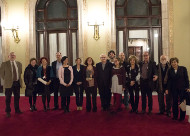
The International Catalan Institute for Peace (ICIP) presented the 2016 Peace in Progress Award to the NGO Peace Brigades International (PBI) for their work in the support and accompaniment of human rights defenders. The event took place in the Parliament of Catalonia on Tuesday 7 February and was attended by approximately one hundred people.
The ceremony was chaired by the President of Parliament, Carme Forcadell, and ICIP president Xavier Masllorens. On the part of the award-winning organization, the representative of PBI Spain, Montserrat García, picked up the award, while the commentary was given by the historic human rights activist and current Member of Congress in Guatemala, Nineth Montenegro.
ICIP president Xavier Masllorens justified recognition for PBI because “standing by those whose most fundamental rights are violated, and who risk their lives and safety, accompanying them, is at the very heart of the ethic of care that we promote from the institutions that work for peace.”
The importance of the work carried out by Peace Brigades International was made clear with the emotional testimony of human rights activist Nineth Montenegro, founder of the Mutual Support Group (GAM), an organization formed by relatives of the disappeared in Guatemala, who was supported and protected by PBI in the 1980s after she denounced the abduction and disappearance of her husband: “Neither my daughter nor I would be alive if it were not for the commendable, selfless and self-sacrificing work of members of the Brigades. […] They gave me the opportunity to stand up today in Guatemala and keep fighting for a better country.”
During the ceremony a video about Peace Brigades International was shown, and then Professor Antoni Pigrau, member of the ICIP Governing Board, read the conferment statement. The award was presented to the international representative of PBI Spain, Montserrat García, who dedicated it to all human rights defenders, “with the hope that it will contribute to make the important work they do more visible, and for which they face threats, attacks and persecution.” In her speech, García regretted that “unfortunately, the world remains a dangerous place to defend human rights and the need for international support is growing.” The international representative of PBI also highlighted “the hundreds of volunteers” who have been members of PBI teams and who are one of the “fundamental pillars” of the organization.
In the closing ceremony, the President of Parliament, Carme Forcadell, congratulated the International Brigades and stated that they were a “necessary model” because “we need to have examples that reinforce the culture of peace in our society.” Forcadell said that “peace is much more than the absence of violence,” because “there can be no peace without respect for human rights and dignity. There is no peace without freedom and justice.”
Inspired by Gandhi’s nonviolent techniques, Peace Brigades International was founded in 1981 with the conviction that the presence of international volunteers could deter attacks against the civilian population in conflict areas. Thus, for 35 years, they have been working in conflict areas, where their volunteers provide support to human rights activists and other groups and organizations that are threatened, such as unions or indigenous communities. They currently have permanent teams in Guatemala, Colombia, Mexico, Honduras, Nepal, Indonesia and Kenya, and they have also worked in Sri Lanka, the Balkans, El Salvador, Haiti and East Timor.
The ICIP Peace in Progress Award is granted annually and consists of public recognition, a sculpture created by Nobel Peace Prize winner, activist and artist Adolfo Pérez Esquivel, called Porta del Sol, and a financial prize of 4,000 euros.
Full video of the ceremony (Canal Parlament)
Social Sciences Textbooks Are Lacking in Education for Peace
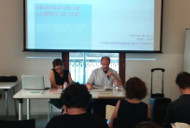
A study carried out by ICIP and the UAB School for a Culture of Peace on the values transmitted in social sciences textbooks used in the third year of Compulsory Secondary Education (ESO) has found that they do not adhere to peace education criteria.
The report, the result of work carried out in 2016 by a multidisciplinary research team, analyzes the contents of seven books by Catalan publishers on the basis of six perspectives: peace and conflict; socioeconomic development; gender; intercultural diversity; the environment; and human rights and democracy. A seventh area deals with the methodologies of learning exercises.
The document states that the textbooks have a very explicit discourse in accordance with the values of peace education. However, in the implicit discourse, several shortcomings and imbalances have been observed in each perspective. According to the findings of the study, 93 percent of the individuals mentioned are men –mostly Europeans– and there are almost no women or representatives of other cultures. As for social classes, disadvantaged groups are clearly underrepresented and, although poverty is discussed in depth, it is presented as a phenomenon of developing countries, with no analysis of the inequalities present in developed countries.
One of the strengths of the textbooks, and the issue that is dealt with the most, is their crosscutting perspective on the environment. On the other hand, gender and diversity are the most neglected issues. Extremely pronounced biases have been observed regarding gender (men: 92.9 percent; women: 7.1 percent) and the countries of origin of these people (European: 95.4 percent; from other continents: 4.6 percent).
According to the study’s conclusions, the main challenges to improve peace education in textbooks are reinforcing the mainstreaming of the perspectives and avoiding the overrepresentation of certain narratives. To this end, it is recommended to introduce more examples of episodes of peace and nonviolent actions –not just wars–; reflect the human consequences of violent episodes; and reflect on various economic models and possible alternatives.
Given the limitation of space available in textbooks and of instruction time in the classroom, the report does not seek to add additional content but rather to incorporate different crosscutting perspectives to explain each topic. The study shows that it is possible to educate in values while providing sufficient elements for students to learn to deliberate and develop critical thinking.
Understanding Violence is Key to Transforming It
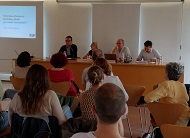
As part of the process of reflection and thematic focus initiated by ICIP’s Governing Board, the seminar Violence(s) in Latin America: Causes, Consequences and Opportunities for Peacebuilding took place on Tuesday 30 May at the Can Sisteré Center for Contemporary Art in Santa Coloma de Gramenet.
The seminar focused on analyzing the nature, causes and consequences of the multiple types of structural violence particularly affecting Latin America beyond the dynamics of armed conflicts. This violence is widespread in countries like Brazil, Colombia, El Salvador, Guatemala, Mexico and Honduras (74 percent of the people who die violent deaths do so in a context of unarmed conflict). These types of violence have scarcely been analyzed with the theory of conflict analysis and peacebuilding and respond to complex rationales: contexts of institutional weakness with high levels of inequality, social exclusion and vulnerability.
In the inaugural conference, economist Luis Jorge Garay contextualized the phenomenon of these unconventional types of violence: new forms of criminality that exist in multiple dimensions (economic, political and social), in multiple locations (they are both a national and transnational phenomenon) and that are structural in nature because they are deeply rooted in both public and private institutions. Juan Carlos Garzón, a researcher at the Fundación Ideas para la Paz (Ideas for Peace Foundation), agreed with this main idea and added that in Latin America it is often the criminal organizations that guide the behavior of the State.
In his presentation, Garzón noted the high levels of violence that exist in Latin America, mainly in the cities (with 8 percent of the world’s population, the region accounts for 33 percent of the world’s homicides). For his part, Stephan Sakalian, of the International Committee of the Red Cross, highlighted the “invisible effects” of violence, beyond the homicides: internal displacement, threats, extortions, sexual violence, impact on mental health and disappearances.
In a roundtable discussion, the seminar also analyzed policy responses in countries like Honduras, Guatemala and El Salvador, revealing that hardline policies and securitization contribute to increased violence rather than to its transformation. In this regard, for example, researcher Sergio Maydeu noted that securitization has significant economic and social impacts, and that a comprehensive response to these types of violence is necessary, based on integration policies and economic opportunities for the population. Regarding the specific case of El Salvador, journalist Roberto Valencia described a harsh reality marked by the criminality of the “maras”, or gangs, which in his view are the main generators of violence. The seminar also discussed the war on drugs and the role of youth gangs, and ended with a panel discussion on peacebuilding and resilience strategies, with the work carried out by the activist Valdènia Paulino in poor and violent communities in Sao Paulo, and the project on reconciliation in El Salvador led by the professor and Marist Jaime Comabella.
In the concluding remarks, the professor and member of ICIP’s Governing Board, Oscar Mateos, emphasized the importance of understanding these other types of violence in order to transform them and thus open up new areas of study and research of this phenomenon to build new methodologies based on the experiences of peacebuilding that exist at a local level. Finally, he also put on the table the need for a greater involvement of international actors to give the situation more visibility.
Vídeos of the seminar
ICIP expresses concern about the presence of the Army at the Education Fair
ICIP president Xavier Masllorens has sent a letter to Fira de Barcelona to express his concern and disagreement with the decision taken by the Executive Council of the trade fair organization to maintain and expand the exhibition space for the Army at the Education Fair, which will take place from 22-26 March in Barcelona.
The letter highlights that the decision contradicts the criteria regarding demilitarization of the Barcelona City Council and the Parliament of Catalonia, which are also members of the highest governing body of Fira de Barcelona. Xavier Masllorens regretted that the offer of dialogue by the platform Demilitaritzem l’Educació (Let’s Demilitarize Education) wasn’t taken into account either. This platform consists of roughly seventy different organizations, such as the UNESCO Center of Catalonia, the Barcelona Youth Council and student unions.
The ICIP president invited Fira de Barcelona “to reflect on the meaning and principles that should govern the Education Fair,” one of the most important events in the field of education in Catalonia, and “to reconsider the decision” to allow a military presence at the fair.