Film Launch: ‘Reescribiendo el exilio’

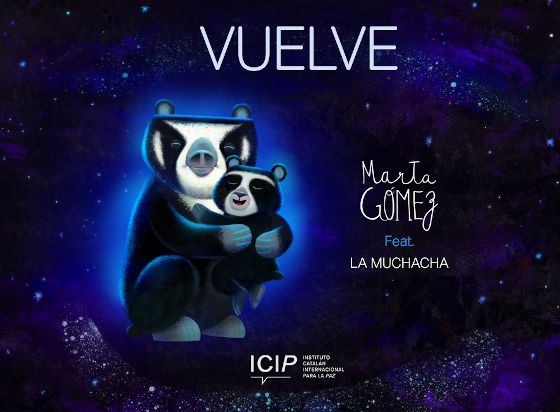
To help the Colombian exile to get out of anonymity. This is the main goal of the documentary Reescribiendo el exilio (Rewriting exile), a film produced by ICIP and the Colombian Truth Commission.

The 21-minute film tells the stories of the children of Colombian exiles who live in different European countries and who, as a consequence of the Colombian armed conflict, grew up – or were born – in other territories and cultures.

The documentary was directed by Mónica Granda Restrepo, a Colombian filmmaker and journalist exiled in Switzerland.

“The documentary talks about putting words into this exile because what really happened in Colombia is that these stories are unknown and have been silenced, not only inside the country but also abroad.”

“In Colombia, no one knows that we have exiles and abroad. When I say that I am a Colombian exile, people look at me with a strange face”, said the filmmaker.

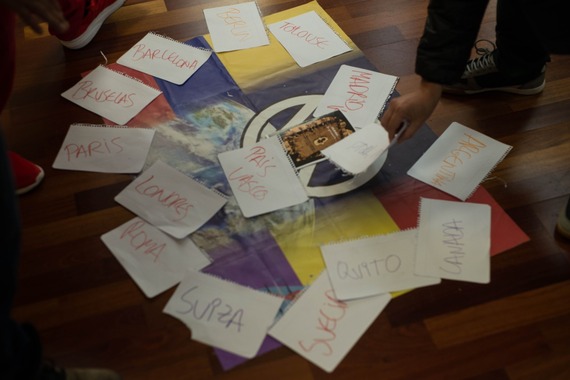
Reescribiendo el exilio collects the testimonies of Nicolás, Karim, Alejandra and Andrea and shows images recorded at the second generation meeting held by the Colombian Truth Commission in Bilbao in 2019.

“Since we were little, we’ve had parallel but different stories. It’s something that not everyone understands. During the meeting seen in the documentary, we connected as if we had known each other all our lives.”

“For many of us, it was the first time to see each other. It has been a long process and with a lot of uncertainty, but thanks to these experiences provided by the Colombian Truth Commission, we have been able to understand a little more our personal situation and the situation of the Colombian people”, explained Nicolás Forero Rodríguez, one of the youths featured in the film.

The documentary was premiered on June 5 at an event with the participation of the film’s director and several members of the second-generation group in exile.

During the presentation, the youth talked about the past, present and future of the sons and daughters of those people who had to leave Colombia forcibly.

The event was moderated by Sílvia Plana, one of the people in charge of the Memory, coexistence and reconciliation work area of the ICIP.

You can rewatch it on the Colombian Truth Commission’s YouTube channel.

Reescribiendo el exilio has been possible thanks to the collaboration of the ICIP, the Catalan Agency for Cooperation to the Development and the Colombian Truth Commission.

ICIP promotes a dialogue workshop for influential young people linked to different political parties and civil society

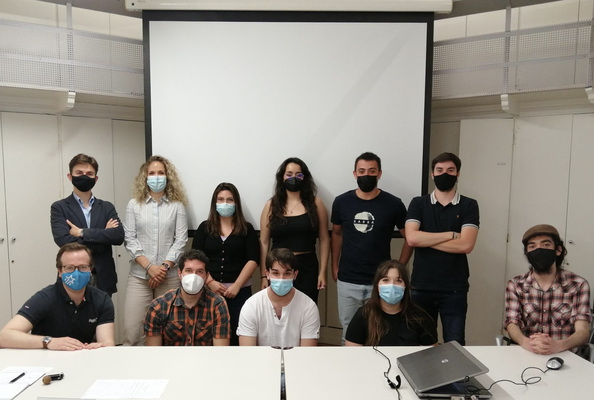
A group of young people with responsibility in political parties and social organizations in Catalonia participated in a training workshop on organizational leadership skills promoted by ICIP. The goal of the workshop was to strengthen the skills of difficult but respectful dialogue.

In total, they took part in four sessions, of four hours each, on May 14, 15, 21 and 22. The participants were:

According to ICIP director Kristian Herbolzheimer, “global political and social challenges require a new way of understanding leadership and the ability to coexist in a constructive discrepancy.” Herbolzheimer noted that “this exercise generates a different type of conversation than the usual political confrontation and helps to become aware of perspectives different from one’s own.”

After four days of activities, the group gave a very positive assessment of the workshops promoted by ICIP. “These have been a few days of work where different internal, social and organizational conflicts have been raised and through individual and group work we have been able to develop the ideal leadership skills to meet these present and future challenges,” summed up Olympia Arango, vice president of deba-t.org.

The training was based on the Adaptive Leadership methodology developed at Harvard University. The programme brings together a group of people with diverse perspectives and invites them to participate in real-time analysis, reflection and practice exercises. This can involve challenging conversations and ideas that reflect deeply ingrained values and assumptions and clarify how to expand options and capacities for analysis and intervention in political spaces and systems. One of the most significant challenges for participants is presenting and submitting to the group analysis of failed leadership situations.

This programme was promoted by ICIP’s “Social and Political Dialogue” area of work, which aims to offer analysis tools for conflict management and transformation, emphasising promoting dialogue in Catalonia. In this area, ICIP develops various methodological proposals to reach a greater number of people and organizations.

In the photo, standing, from left to right: Ignacio Rigau (Noves Generacions Catalunya), Laura Casado (Jovenes Ciudadanos), Mònica Pujadas (Creu Roja Joventut), Olympia Arango (deba-t.org), Biel López (La Forja) and Marçal Escartín (Jovent Republicà). Sitting, from left to right: Álvaro Clapés-Saganyoles (Joventut Nacionalista de Catalunya), Daniel Martínez (Joventut Socialista de Catalunya), Pablo Jurado (Confluència Jove), Pilar Cortés (Avalot – UGT Jove) and Joan Jordi Abentín (F98).

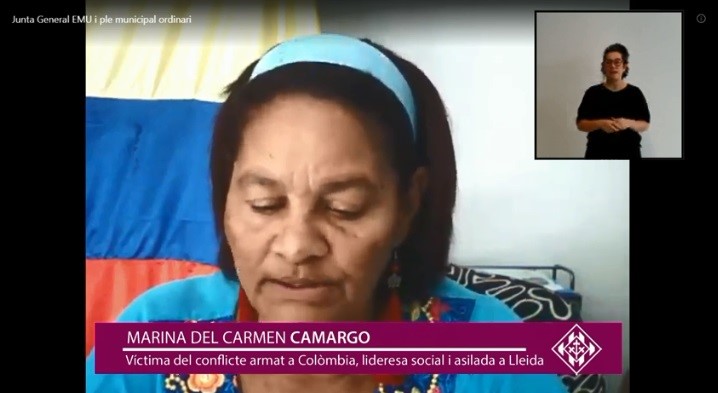
ICIP organizes workshops in Lleida to recognize the victims of the Colombian conflict exiled in Catalonia

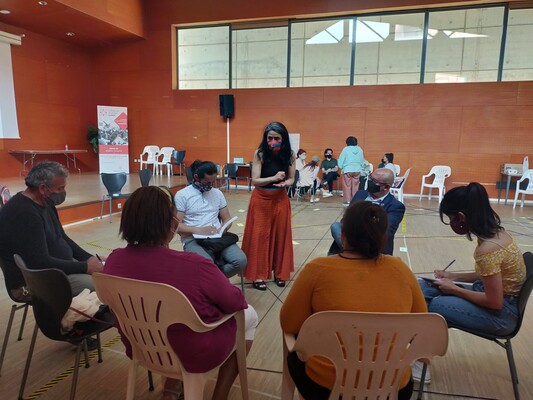
The ICIP, in collaboration with the Nido Catalunya in support of the Colombian Truth Commission, has organized in Lleida, with the support of the City Council, a couple of workshops to promote the recognition of the victims of the Colombian conflict exiled in Catalonia.

These workshops are a pilot test that will soon be extended to Barcelona and are expected to adapt in other municipalities in Catalonia and Europe.

The workshops took place at the Balàfia Civic Center on April 24 and May 16. The first of the workshops focused on the comprehensive system of truth, justice, reparation and non-repetition for Colombian people living in Catalonia. The second focused on recognition to make visible the impacts of the Colombian armed conflict and the migration process of exiled people and contribute to the dignification of the victims.

The workshops aim to provide a general context and sufficient tools to understand and recognize the comprehensive system and spaces for participation for victims abroad.

“They seek to generate and strengthen spaces for participation, dialogue and listening among the exiled population and the Colombian diaspora, social organizations and local governments that contribute to actions of recognition to the victims of the Colombian armed conflict”, explains Ana Isabel Osorio, a technician in the area of “Memory, coexistence and reconciliation” of the ICIP.

The activity was facilitated by Maria del Rosario Vásquez and Bibiana Lopera of the Nido Catalunya, supporting the Colombian Truth Commission.

https://twitter.com/paerialleida/status/1393984250643353608

More workshops in June

A third workshop is planned for June in Lleida.

Following this participatory process, the aim is to have an institutional declaration approved by the City Council of the capital of Segrià to make visible the impacts of the Colombian armed conflict and the migration process of exiled people and contribute to the dignification of victims who had to flee Colombia because of the armed conflict.

Another of these workshops is also planned to be organized in Barcelona in June. These activities aim to strengthen the dialogue between local actors (Colombian population, social organizations and academia and local governments) and contribute to the dissemination of the final report that the Colombian Truth Commission will publish at the end of this year.

The process of recognizing the victims is part of the work carried out by the ICIP as the Technical Secretariat of the Colombian Truth Commission in Europe.

The activities have the support of The Catalan Agency for Cooperation to the Development (Agència Catalana de Cooperació al Desenvolupament – ACCD).